A sports injury rarely arrives at a convenient time. It may interrupt a tournament, a fitness goal or the one hour of the day you reserve for yourself. The temptation is to test it repeatedly, rest until it feels quiet, and then return at full intensity. That cycle is one reason apparently small injuries often return.
Sports injury physiotherapy connects diagnosis and symptom management with the demands of training. The aim is not only to make the injured area feel better; it is to rebuild the capacity, movement skill and confidence required by your sport.
What counts as a sports injury?
Sports injuries include sudden events such as ankle sprains, muscle tears and ligament injuries, as well as gradual problems such as tendon pain, shin discomfort and repeated shoulder symptoms. Gym training, running, recreational games and physically demanding occupations can create similar loading problems.
Pain location alone does not reveal the cause. The assessment considers how the injury happened, recent changes in training, previous problems, recovery, equipment and the specific movement that now feels difficult.
Practical takeaway: Describe what changed before the injury, not only where it hurts today.
The first assessment: diagnosis meets performance
Your physiotherapist will screen for fractures, major ligament injuries and other conditions that may need imaging or specialist review. Movement, strength, joint mobility, balance and sport-specific tasks are then assessed. When appropriate, the opposite side provides a useful comparison, though it is not always a perfect benchmark.
The conversation should also cover your position, competition level and next important date. A plan for an elite athlete in season may differ from one for a weekend player, but both should prioritise safe progression.
Practical takeaway: A sports assessment should explain both the injury and the demands you must rebuild.
Treatment is more than rest and machines
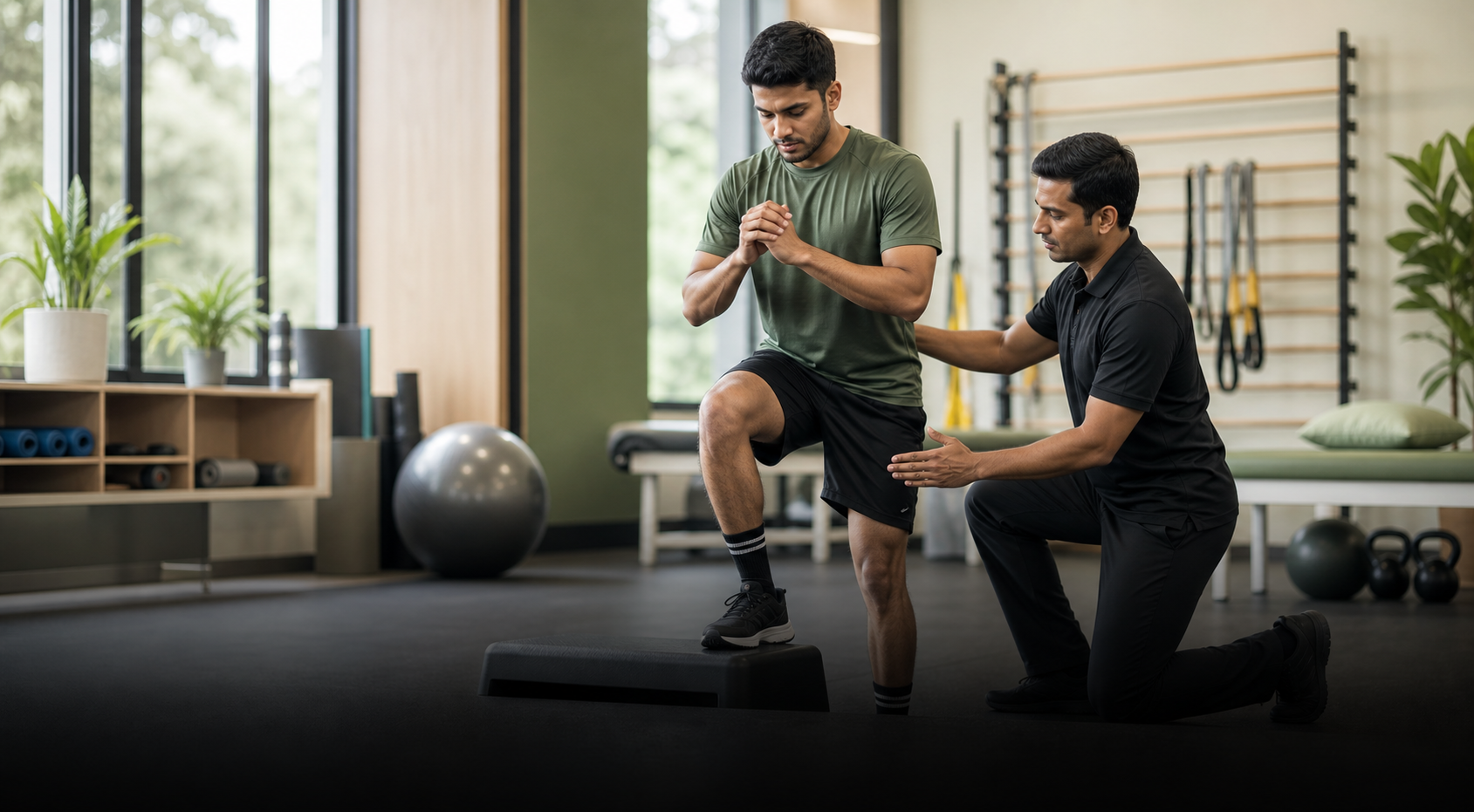
Early care may include load modification, education and hands-on treatment when useful. The centre of rehabilitation is progressive exercise: restoring movement, building strength, improving control and increasing tolerance for speed or impact. Passive treatment alone does not prepare tissue for sport.
Pain is one guide, but the next-day response matters too. Training can often continue in a modified form so that overall fitness and unaffected areas are maintained. The goal is intelligent loading rather than complete shutdown.
Practical takeaway: Keep the athlete training safely whenever possible, while protecting the injured structure.
How training load influences recovery
Injuries often appear after a sudden increase in running distance, match exposure, gym volume or intensity. Rehabilitation therefore includes a plan for how much work to do and how quickly to increase it. Sleep, nutrition, travel and stress can change how well that workload is tolerated.
A simple training diary can record session type, duration, effort and symptoms later that day or the next morning. Patterns become easier to see, and progression becomes a decision rather than a guess.
Practical takeaway: Increase demand in steps and monitor how the body responds over 24 hours.
Return-to-sport testing and confidence
Feeling pain-free in daily life does not prove readiness for sprinting, jumping, throwing or contact. Testing may include strength, repeated effort, hop or landing tasks, agility and sport-specific drills. The selection depends on the injury and activity.
Confidence is a performance quality. Athletes who hesitate or protect one side may need graded exposure to feared movements. Rehabilitation should create successful repetitions under increasing speed, complexity and fatigue.
Practical takeaway: Return to sport should be demonstrated through relevant tasks, not assumed from the absence of pain.
Choosing a sports physiotherapist in Noida
Look for a physiotherapist who understands your sport, communicates with coaches or doctors when needed and measures progress. Ask how the clinic decides when to run, train and compete again. Clear criteria are more useful than promises of a quick cure.
Aceso Physiotherapy in Sector 141 works with athletes and active adults across injury rehabilitation and return-to-performance planning. Bring footwear, training details and any reports that can help recreate the demands of your activity.
Practical takeaway: Choose a rehabilitation process that prepares you for your sport, not only for the treatment table.
Explore related physiotherapy care
Frequently asked questions
Should I stop all exercise after a sports injury?+
Not always. Training can often be modified to protect the injured area while maintaining fitness and strength. The right level depends on the diagnosis and symptom response.
When is a scan needed?+
Imaging may be helpful when examination suggests a fracture, significant tissue injury or another condition that changes management. It is not automatically necessary for every sports injury.
Can physiotherapy reduce re-injury risk?+
Rehabilitation can address strength, control, workload and sport-specific capacity linked with re-injury risk, although no programme can remove risk completely.
Clinical references
WHO: Rehabilitation ↗Aspetar sports rehabilitation guidance ↗This article is for general education and does not replace an individual assessment. Seek urgent medical care for severe, rapidly worsening or neurological symptoms, or after significant trauma.