A knee can be injured during sport, a twist on uneven ground, a fall or a gradual increase in activity. The first few days are confusing because swelling, pain and fear can make every movement feel risky. Yet doing too little for too long can also lead to stiffness and weakness.
Safe recovery balances protection with appropriate loading. The right plan depends on the structure involved, the severity of injury and your goals. This guide explains the principles without attempting to diagnose a knee online.
Know when a knee injury needs urgent review
Seek prompt medical assessment if the knee is badly swollen or deformed, you cannot take weight, the joint is hot and red with fever, or it locks and cannot straighten. A pop during injury followed by rapid swelling or repeated giving way may indicate a significant ligament or internal joint injury.
After major trauma, do not repeatedly test the knee. Protect it, arrange appropriate medical assessment and use support only as advised.
Practical takeaway: Inability to bear weight, deformity, a locked knee or fever with redness requires timely medical care.
The first days: protect without becoming completely inactive
Reduce activities that clearly increase pain or swelling. Compression, elevation and short periods of wrapped cold may provide comfort for some injuries. Begin gentle movement when appropriate to limit stiffness, but follow medical restrictions after fracture or surgery.
The response later that day and the next morning helps determine whether the dose was suitable. A small temporary increase may be acceptable; a large increase in swelling, limping or loss of movement means the activity should be adjusted.
Practical takeaway: Use symptoms to find the right amount of early movement rather than choosing total rest or forced exercise.
Restore movement and a confident walking pattern
Knee extension is particularly important for normal walking, while flexion supports stairs, sitting and squatting. Rehabilitation often begins with controlled bending and straightening, muscle activation and a gradual return to even weight bearing.
Walking with a persistent limp can overload other areas. Crutches or temporary support may be useful when prescribed, but they should be reviewed as strength and control improve.
Practical takeaway: Aim for comfortable range and good walking quality before chasing distance.
Strength is the bridge back to activity
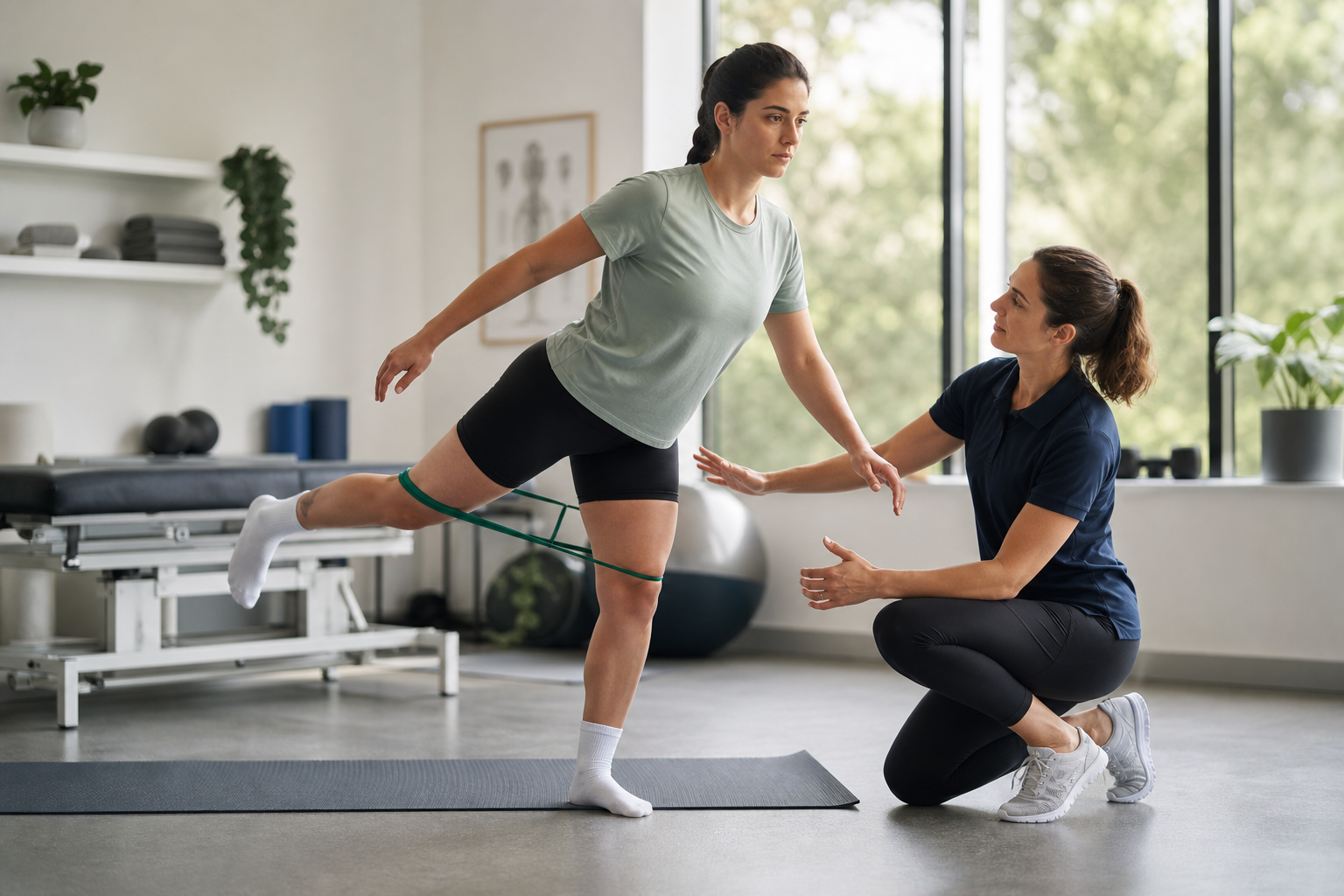
Quadriceps, hamstrings, calf and hip muscles all contribute to knee control. Strengthening progresses from basic contractions and supported exercises to squats, step work, single-leg tasks and heavier loading when appropriate.
Regular measurement prevents guesswork. Repetitions, resistance, movement quality and next-day symptoms provide a clearer picture than pain alone. For athletic goals, strength and power eventually need to approach the demands of running and sport.
Practical takeaway: Build the whole lower limb and measure progress over time.
Balance, direction changes and return to running
Once basic strength is established, rehabilitation adds balance, landing and control during more complex tasks. Running is introduced gradually and only when the knee tolerates walking, repeated loading and suitable strength without significant swelling.
Return to sport includes acceleration, braking, change of direction and fatigue. These skills should be practised before full competition rather than tested for the first time in a match.
Practical takeaway: Prepare for the hardest demand of your activity before declaring rehabilitation complete.
Knee injury physiotherapy in Noida
A structured assessment can distinguish between injuries that can begin physiotherapy and those needing orthopaedic or imaging review. At Aceso Physiotherapy, Sector 141, rehabilitation is linked to goals such as stairs, commuting, gym training, running or competitive sport.
Bring any scan or surgical documents and explain how the knee behaves over 24 hours. This helps establish a safe starting load and measurable milestones.
Practical takeaway: A clear diagnosis pathway and staged loading plan remove much of the uncertainty from knee recovery.
Explore related physiotherapy care
Frequently asked questions
Should I use ice after a knee injury?+
Wrapped cold can provide short-term comfort for some people. Avoid direct skin contact and remember that it does not replace assessment, appropriate loading or rehabilitation.
When can I start running again?+
Readiness depends on swelling, motion, strength, repeated loading and the injury itself. A date alone is not enough; clinical and functional milestones should guide return.
Why does my knee click?+
Painless clicking is common. Clicking with pain, swelling, locking or giving way deserves assessment, particularly after an injury.
Clinical references
NHS: Knee pain and urgent warning signs ↗NICE: Therapeutic exercise for knee osteoarthritis ↗This article is for general education and does not replace an individual assessment. Seek urgent medical care for severe, rapidly worsening or neurological symptoms, or after significant trauma.