An ACL injury changes more than the stability of the knee. It can affect confidence, muscle strength, training plans and the way an athlete trusts cutting, landing or slowing down. That is why ACL rehabilitation is not a collection of knee exercises and it is not a race to reach a date on the calendar.
Whether treatment is surgical or non-surgical, rehabilitation moves through overlapping stages. Each stage has a purpose and clear signs of readiness for the next one. The exact timeline varies with swelling, range of motion, strength, graft healing, associated injuries, sport and medical advice.
Before rehabilitation begins: establish the full picture
ACL injuries may occur with meniscus, cartilage or other ligament injuries. The starting plan should reflect the diagnosis, the person's activity goals and, after surgery, the surgeon's instructions. Early discussion also helps set realistic expectations about work, driving, training and return to sport.
Prehabilitation before reconstruction may focus on reducing swelling, restoring knee extension, improving quadriceps activation and preparing the person for the post-operative routine. Even one well-planned pre-operative session can improve understanding and confidence.
Practical takeaway: The best starting point is a shared plan between the patient, physiotherapist and surgeon where surgery is involved.
Stage 1: settle the knee and restore basic control
The early phase prioritises swelling management, full knee extension, gradually improving flexion and waking the quadriceps back up. Walking quality matters: protecting the knee does not mean keeping it completely still, but loading must respect pain, swelling and surgical restrictions.
Progress is monitored through the knee's response over the following day. A large increase in swelling or loss of movement suggests that the workload was too high. Good early rehabilitation is calm and consistent rather than dramatic.
Practical takeaway: A quieter knee, full extension and reliable quadriceps activation are more important than rushing to difficult exercises.
Stage 2: rebuild strength, balance and everyday function
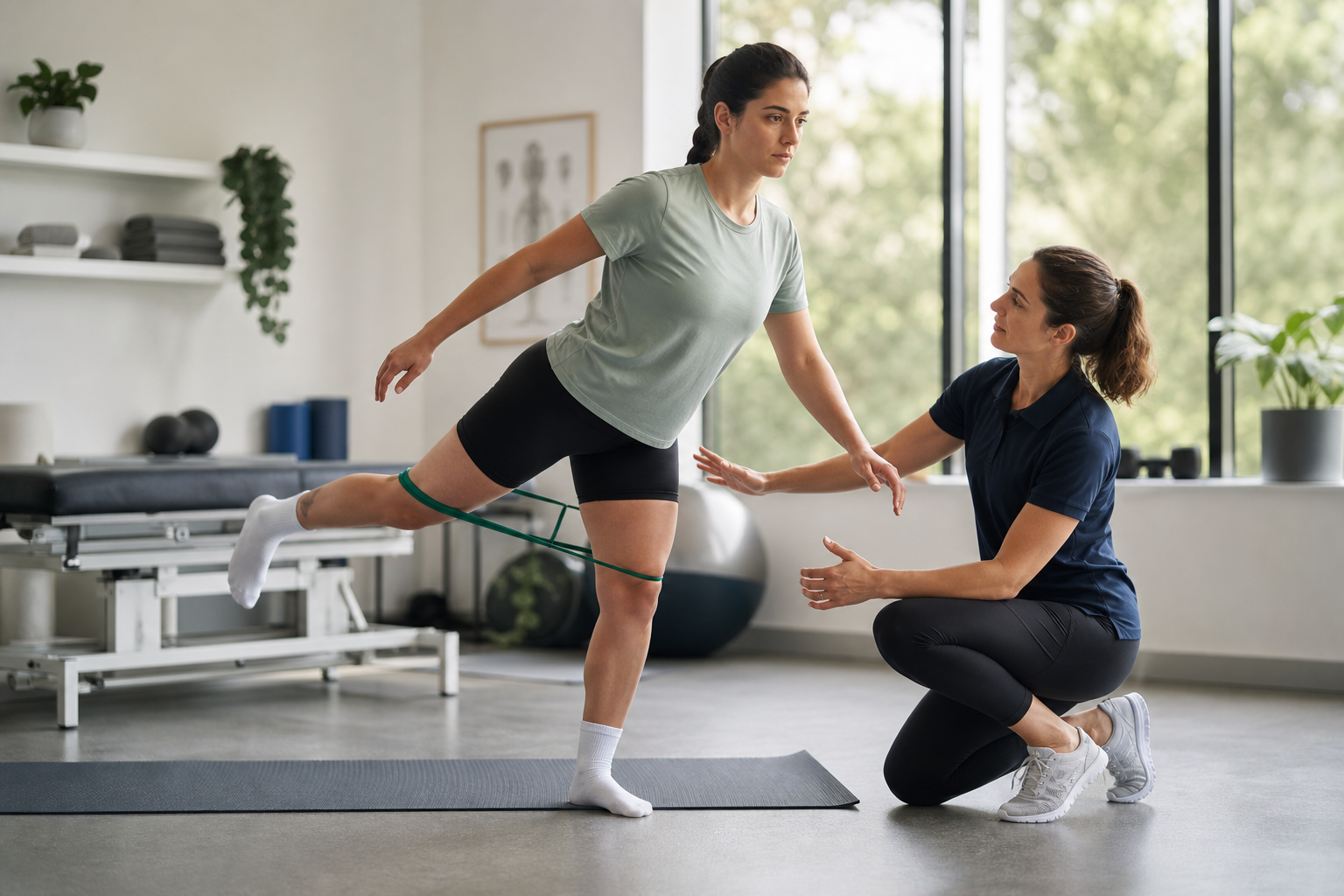
As movement improves, the programme develops strength in the quadriceps, hamstrings, calf and hip. Squats, step patterns, controlled single-leg tasks and balance work may be introduced and progressed according to the individual. Exercise choice changes if there is a meniscus repair or another restriction.
The goal is not simply to complete repetitions. The injured leg needs to accept load without compensation, and the person should regain confidence in stairs, prolonged walking and daily movement. Objective strength measures are useful because the stronger leg can hide a large deficit.
Practical takeaway: Quality and measurable strength matter more than how advanced an exercise looks.
Stage 3: prepare for running, jumping and landing
Running should begin only after suitable clinical and functional milestones. These commonly include minimal swelling, near-normal range of motion, adequate quadriceps strength and the ability to tolerate repeated single-leg loading. The first running exposure is controlled and increased gradually.
Jumping and landing are taught before high-speed changes of direction. Video, force measures or structured observation can reveal whether the athlete shifts away from the recovering knee. Good rehabilitation rebuilds the ability to produce force and absorb it.
Practical takeaway: Running is a tested milestone within rehabilitation, not an automatic reward for reaching a certain month.
Stage 4: return to training before return to competition
Sport-specific rehabilitation recreates the demands of the athlete's role: acceleration, deceleration, cutting, reacting, fatigue and contact where relevant. A footballer, kabaddi player and recreational runner do not need identical return-to-sport plans.
Return-to-sport testing may include strength symmetry, hop and jump performance, movement quality, knee symptoms and psychological readiness. Passing a test does not instantly mean full competition. Athletes usually progress through individual drills, team training, controlled minutes and then unrestricted play.
Practical takeaway: Returning to practice and returning to peak performance are different milestones.
Common ACL rehabilitation mistakes
Frequent mistakes include chasing range aggressively when the knee is swollen, progressing because time has passed, training only the quadriceps, ignoring the other leg and stopping rehabilitation once jogging feels comfortable. Fear of re-injury can also remain hidden until cutting or competition resumes.
A structured ACL rehabilitation programme in Noida should combine regular reassessment with a plan the athlete can follow between appointments. Consistency, recovery and honest reporting of symptoms are essential.
Practical takeaway: A successful ACL programme builds strength, skill and trust in the knee - not just a pain-free jog.
Explore related physiotherapy care
Frequently asked questions
How long does ACL rehabilitation take?+
There is no single safe duration. Progress depends on the injury, surgery, associated tissue damage, strength, symptoms, sport and objective readiness. Return to pivoting sport is criteria-based and commonly requires many months.
Can an ACL injury recover without surgery?+
Some people may manage successfully without reconstruction, depending on knee stability, associated injuries and activity goals. The decision should be made with an orthopaedic specialist and rehabilitation team.
Why is my thigh smaller after ACL injury?+
Quadriceps inhibition and reduced loading can lead to rapid muscle loss. Early activation and progressive strengthening are central parts of rehabilitation, within medical restrictions.
Clinical references
Aspetar: Clinical practice guideline after ACL reconstruction ↗WHO: Rehabilitation and everyday function ↗This article is for general education and does not replace an individual assessment. Seek urgent medical care for severe, rapidly worsening or neurological symptoms, or after significant trauma.